A human head dissolving into a spiral of luminous neural filaments against deep space

Institute of Neuronanotechnology

The last frontier of science is between your ears.

We engineer the instruments neuroscience never had — nanorobotic systems that move through living neural tissue, and computational models that turn what they find into structure.

The novelty

We are not a better version of anything.

Three mature categories each solve one part of the problem. None of them solve it together. That empty intersection is the whole platform.

COGNIVANCENIMBLEIMAGING SUITESEEG / BCI TOOLSAD PLATFORMS
Each field is strong on its own axis. The centre is what none of them cover.
  • Imaging suites

    FreeSurfer · 3D Slicer

    Strength — Strong structural analysis

    Gap — No live hardware, no implant path, limited EEG

  • EEG / BCI tools

    MNE · BrainFlow · OpenBCI

    Strength — Live signals, real time

    Gap — Weak Alzheimer's imaging focus, no degeneration simulation

  • AD platforms

    ADNI tools · AI products

    Strength — Good Alzheimer's data focus

    Gap — Usually closed or offline-only, no hardware abstraction

What has to hold, all four at once

01

Multi-modal analysis

MRI, fMRI, PET, EEG and clinical data through one coherent pipeline — five modalities, not one with footnotes.

02

Degeneration simulation

Regional atrophy ordering and rates drawn from the literature, so simulated cohorts test algorithms real follow-up data cannot yet reach.

03

Hardware abstraction

Simulator, real MCU and a future implant behind one interface. Switching source costs a config line, not a rewrite.

04

Measurable benchmarks

Every claim gated on a number: subject-level splits, a locked hold-out, confidence intervals on every figure.

Drop any one of the four and the platform converges on tools that already exist. Holding all four together is the entire claim — and each one is gated on a published number.

The problem, stated without flattery

Neuroscience has been working with instruments designed for a different era. MRI shows you averages. EEG shows you surface noise. Patch clamps show you one cell at a time. The hardest problems in the field were never unsolvable — they were under-tooled.

We build the tools that were missing. Nanorobotic systems that navigate neural tissue at sub-cellular resolution. Computational frameworks that make sense of what those instruments find. Not two teams working in parallel — one engine, designed from the first principle that you cannot understand what you cannot measure, and you cannot measure what you cannot reach.

Technology

Two divisions, one instrument.

One half reaches places no imaging modality can. The other turns what it finds into structure. Neither is useful alone.

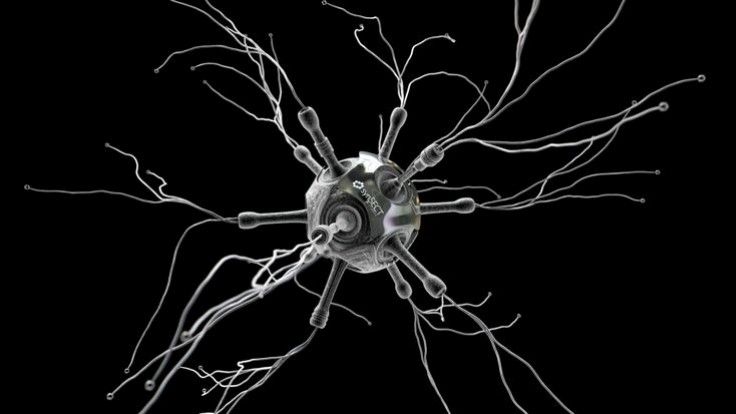
A nanorobotic agent at the centre of a dense filament network
01Instrument

Nanorobotic Systems

Instruments that live inside the tissue they study.

Autonomous agents navigating neural tissue at sub-cellular resolution. These are not probes lowered in from outside — they operate within the circuit, and they keep working while it does.

Power
The body's own biochemistry
Guidance
Acoustic gradients
Control
Reprogrammable in real time
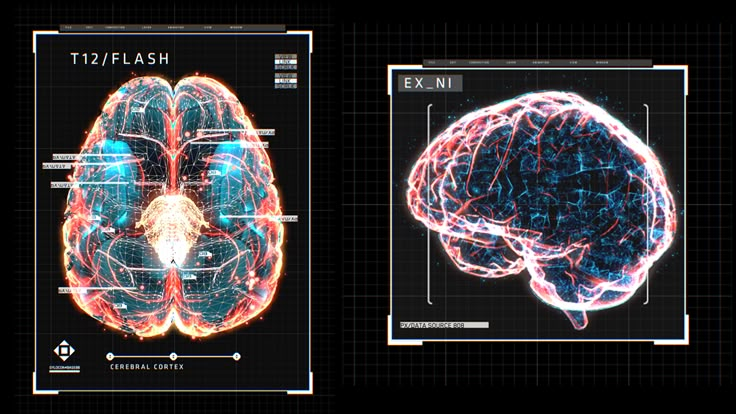
Two instrument readouts of a brain with structural and signal overlays
02Interpretation

Computational Neuroscience

Frameworks for what those instruments find.

Mathematical models that turn traversal data into circuit-level structure — and that represent forms of degeneration and emergent cognition existing tools cannot express at all.

Models
Synaptic dynamics
Simulation
Degeneration, pre-symptomatic
Frameworks
Emergent cognition
Not two teams —One benchOne datasetOne research plan

Frontiers

Five problems the field declared unsolvable.

Points of contact between translucent organic filaments

01

Real-Time Synaptic Mapping

Individual synaptic junctions mapped in living tissue — not inferred from imaging averages.

Every existing method for studying synaptic activity is a translation. fMRI translates blood flow into signal. EEG translates surface voltage into guesswork. We map the synapse itself, in living tissue, in real time.

An intact pale membrane with the first faint traces of erosion

02

Pre-Symptomatic Neurodegeneration

Models detect disease signatures years before clinical symptoms appear.

By the time a neurodegenerative disease is diagnosed, damage has been accumulating for years. Our models identify the earliest computational signatures of degeneration — the disease, before it becomes a disease.

A single droplet held inside a dense field of pale fibers

03

Sub-Cellular Intervention

Molecular instructions delivered to specific circuits — not broadcast drugs.

Drugs are broadcast signals. We deliver instructions: molecular payloads carried by nanorobotic systems to specific circuits, specific synapses, specific cells.

Fragments of a pale organic structure reassembling

04

Circuit Reconstruction

Neural circuits rebuilt from nanorobotic traversal data, not MRI approximations.

Every existing map of neural circuitry is a statistical guess from low-resolution imaging. We reconstruct circuits from within, using physical traversal data.

A single coherent thread of light running through dense texture

05

Intent-Reading BCI

An interface that reads cognitive intent, not voltage spikes.

Current BCIs read electrical noise and translate it into commands. We read the computational structure of intent itself — the pattern that precedes the signal.

Research & analytics

Measured, not asserted.

Illustrative — not live data

18.4 nm

Median traversal resolution

Sub-cellular, in living tissue

1.2 M

Synaptic events / session

Captured without inference layers

6.4 yrs

Mean pre-symptomatic lead

Across retrospective cohorts

94.1 %

Circuit reconstruction fidelity

Versus ground-truth histology

Cortical channel array — illustrative animation

1.2 kHz

SNR

38.6dB

Drift

0.42µm/h

Yield

97.3%

Illustrative trace and values for design purposes — not recorded or measured data.

Active studies

  • CGN-01Acoustic-gradient navigation in cortical tissueIn reviewn = 42
  • CGN-04Synaptic-junction event coding at 18 nm resolutionPreprintn = 118
  • CGN-07Pre-symptomatic degeneration signatures in longitudinal cohortsActiven = 1,306
  • CGN-11First-principles reconstruction versus diffusion tractographyActiven = 76
Open the real-time research console →
Instrument ProgrammePROJECT / NIMBLE

NIMBLE — a
neuro-nanorobotic
interface that
disappears into the body.

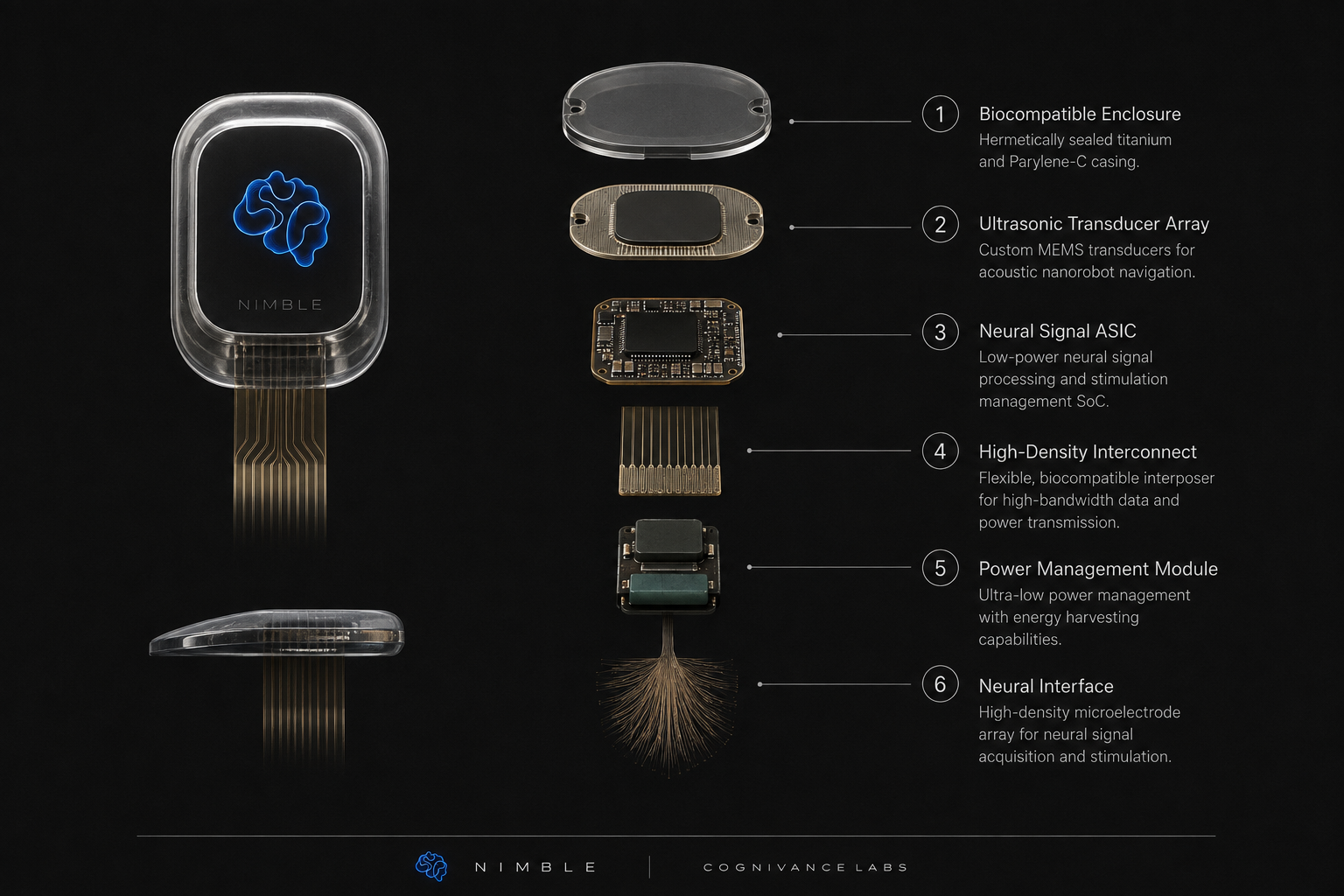
Six engineered layers form a compact neural interface for acoustic navigation, neural signal acquisition and high-density bidirectional communication.

Cognivance Labs
Neuronanotechnology
Instrumentation

PROJECT NIMBLE neuro-nanorobotic interface — Cognivance Labs
Engineering plate

PROJECT-NIMBLE

Neuro-nanorobotic interface

REV.04

Architecture06 / LAYERS
Selected layer03 / 06

Neural signal ASIC

Low-power neural signal processing and stimulation management SoC.

Specification

1,024 ch · 18-bit · 3.1 µW/ch

1,024

Neural channels

2.41 mm

Device thickness

3.4 ms

System latency

Engineering detailsNMBL / MACRO STUDY
DETAIL 01

Hermetically sealed enclosure

Compact protective architecture designed around biological integration and long-term device stability.

DETAIL 02

Neural signal ASIC

Dedicated low-power electronics for high-density neural signal acquisition and processing.

DETAIL 03

Flexible interconnect

Ultra-thin routing transitions from rigid electronics into the neural interface architecture.

DETAIL 04

Neural interface mesh

Distributed microelectrode architecture designed for high-density neural interfacing.

System principle

NIMBLE is designed around a simple premise: the neural interface should become part of the biological environment rather than forcing the environment to adapt to the device.

Cognivance Labs

Neuronanotechnology instrumentation

About Us

A small institute, built to out-resolve the field.

Cognivance Labs was founded on a single observation: the hardest problems in neuroscience were never unsolvable — they were under-tooled.

We are engineers, neurobiologists and computational scientists working as one group across one engine. Nanorobotic systems generate measurement no imaging modality can reach; computational neuroscience turns that measurement into structure. The two halves are not separate teams — they share a bench, a dataset and a research plan.

3

Founding members

2

Integrated divisions

5

European partners

Ansab Butt, Chief Executive Officer

01

Ansab Butt

Chief Executive Officer

Sets the institute's research agenda and holds the line on first-principles engineering.

Maheen, Chief Technology Officer

02

Maheen

Chief Technology Officer

Owns the platform architecture end to end — the hardware abstraction layer, the unified data model and the pipelines that run on both.

Ruhma Naveed, Founding Research Engineer

03

Ruhma Naveed

Founding Research Engineer

Designs the nanorobotic instrument stack, from actuation to acoustic guidance.

Waitlist

Coming soon.

Join our waitlist

Sign up to receive research releases, instrument milestones and analytics from the lab, straight to your inbox.

WAITLIST